

When you’re preparing a mortgage application, the document checklist is only half the equation. The other half is choosing a lender whose process, program access, and pricing structure actually fits your financial profile. For a W-2 borrower at $500,000, almost any retail lender’s checklist will do. For a self-employed buyer at $1,100,000, or an investor qualifying through rental income, the checklist changes entirely — and so does which lender can close the loan.
This guide compares six lenders available to Virginia borrowers in 2026, evaluated by what each actually requires, what programs they can approve, and where their process creates friction for complex files. We’ve also included a note on the NoTouch Credit Pull, a broker-exclusive process that lets you confirm eligibility without a hard inquiry touching your credit report.
Written by Duane Buziak, NMLS #1110647 | Coast2Coast Mortgage LLC, NMLS #376205
How Loan Size and Income Type Determine Your Checklist
The 2026 FHFA conforming loan limit is $806,500 for standard Virginia markets, with a high-cost ceiling of $1,249,125. Any loan above those thresholds enters jumbo territory, where documentation requirements, underwriting standards, and program access vary significantly by lender type.
The CFPB’s mortgage document guidance outlines the standard checklist: two years of tax returns, W-2s, recent pay stubs, two months of bank statements, and asset documentation. That framework works for straightforward W-2 files. It does not work for a self-employed buyer, a DSCR investor, or a borrower qualifying on asset depletion — and retail lenders with a single program shelf often cannot accommodate those scenarios at competitive pricing.
Here is a worked example to frame the comparison. A Virginia purchase at $1,375,000 with 20% down produces a loan amount of $1,100,000. That figure exceeds both the $806,500 baseline and the $1,249,125 high-cost ceiling, placing it firmly in jumbo territory. At a retail lender, that borrower receives one rate, one checklist, and one underwriting standard. At a wholesale broker with multi-lender access, the file is matched to the jumbo investor with the most favorable documentation requirements and the most competitive rate for that borrower’s specific income type.
The lender you choose determines which version of the checklist applies to you.
1. Supra Mortgage
Best for: Complex borrowers, jumbo loans, self-employed, DSCR investors, and anyone who wants eligibility confirmed without a hard credit pull.
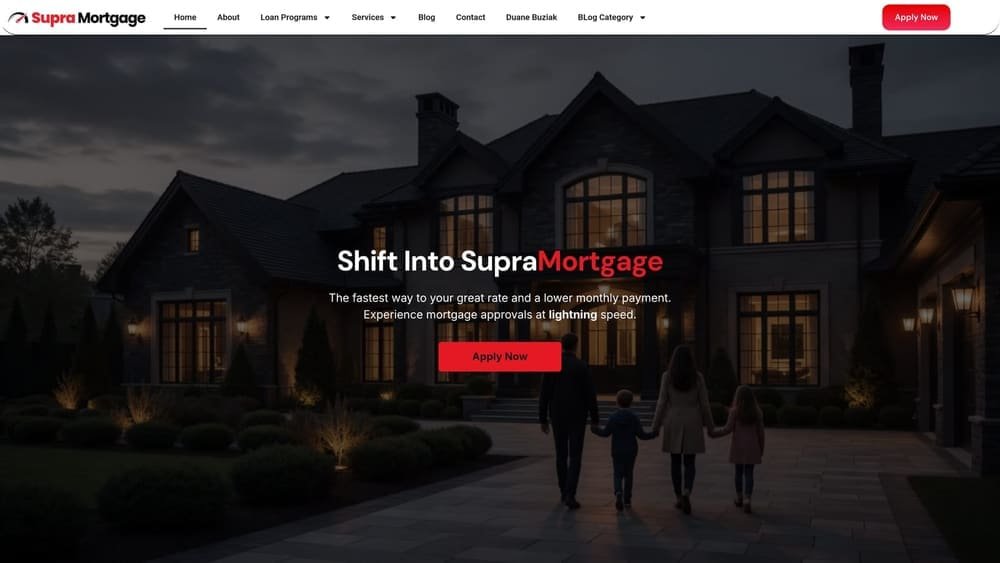
Supra Mortgage is an independent Virginia mortgage broker operating under Coast2Coast Mortgage LLC, NMLS #376205, with wholesale access to more than 500 lenders across jumbo, non-QM, bank statement, DSCR, and high-balance conforming programs. Licensed in VA, FL, TN, GA.
Where This Lender Shines
The structural advantage here is not a feature — it is the model itself. As a wholesale broker, Supra Mortgage does not hold a single rate shelf. When your file comes in, the document checklist is matched to the wholesale lender best suited to your income type, loan size, and program needs. A self-employed borrower at $1,100,000 is not forced into a conventional full-doc template that does not fit.
For borrowers concerned about credit impact, the NoTouch Credit Pull process allows Duane Buziak to run a soft credit pull mortgage review to confirm eligibility, program fit, and indicative pricing before any hard inquiry is initiated. This is a meaningful structural difference from retail lenders, which typically require a hard pull before issuing any pre-approval. If you want a no hard inquiry mortgage pre approval, this is one of the few processes that delivers it.
Key Features
NoTouch Credit Pull: Soft pull mortgage broker process that confirms eligibility and program fit without a hard inquiry on your credit file.
500+ Wholesale Lender Access: Checklist and program are matched to the best-fit wholesale lender for your income type and loan size — not forced into a single retail template.
Jumbo Program Depth: Loans above the $806,500 baseline and beyond the $1,249,125 high-cost ceiling, with multiple jumbo investors available for competitive rate comparison.
Non-QM Programs: Bank statement qualification for self-employed borrowers, DSCR investor loans, and asset depletion qualification — programs most retail lenders do not offer at wholesale pricing.
Wholesale Pricing Structure: No retail markup on rate; pricing reflects wholesale lender cost, not a retail margin layered on top.
Best For
Jumbo borrowers, self-employed buyers, real estate investors using DSCR qualification, high-income professionals with complex income structures, and any borrower who wants a mortgage pre approval without hard pull before committing to a lender. Also well-suited to Virginia move-up buyers purchasing above $806,500 who want competitive rate access across multiple jumbo investors.
Pricing
Wholesale lender pricing varies by program and borrower profile. No publicly disclosed broker fee. Contact Duane Buziak directly at 804-212-8663 for a program-specific quote.
2. Rocket Mortgage
Best for: W-2 borrowers with conventional or FHA needs seeking a fully digital application experience.
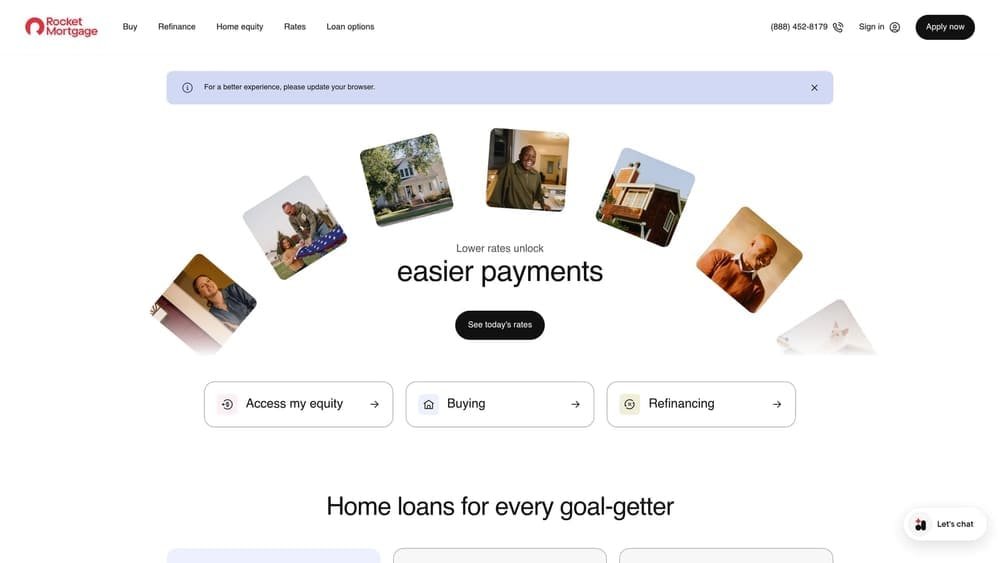
Rocket Mortgage is a high-volume retail direct lender with a fully digital application process and strong name recognition, particularly suited to straightforward W-2 conventional and FHA files.
Where This Lender Shines
Rocket’s digital process is genuinely well-built for clean files. If you are a W-2 borrower purchasing at or below the conforming limit with two years of standard employment history, the upload process is streamlined and conditional approvals can come quickly. For that borrower profile, the experience is efficient.
The limitations emerge above the conforming baseline. Rocket operates on a single retail rate shelf, which means one rate card and one set of underwriting standards. There is no wholesale access, no ability to shop your file across multiple jumbo investors, and limited non-QM program depth. A hard pull is typically required before any formal pre-approval is issued, which is a meaningful difference from a soft pull mortgage broker process.
Key Features
Fully Digital Application: Document upload and application management handled entirely online with a polished interface.
Fast Conditional Approval: Efficient processing for clean W-2 conventional files within the conforming limit.
Single Retail Rate Shelf: One rate card; no wholesale access or multi-lender comparison for your file.
Hard Pull Required: Formal pre-approval typically requires a hard credit inquiry at application.
Limited Jumbo and Non-QM Depth: Program access for complex income types and loans above $806,500 is more limited compared to wholesale broker access.
Best For
W-2 borrowers purchasing within the conforming limit who prioritize a digital-first experience and fast conditional approval for a straightforward file. Less suited to self-employed borrowers, jumbo buyers, or investors needing non-QM qualification.
Pricing
Retail lender fees vary by loan type. Rate quotes require a formal application. Hard pull required for pre-approval.
3. Movement Mortgage
Best for: Purchase-focused buyers with conventional, FHA, VA, or USDA needs who value a fast-close marketing commitment.
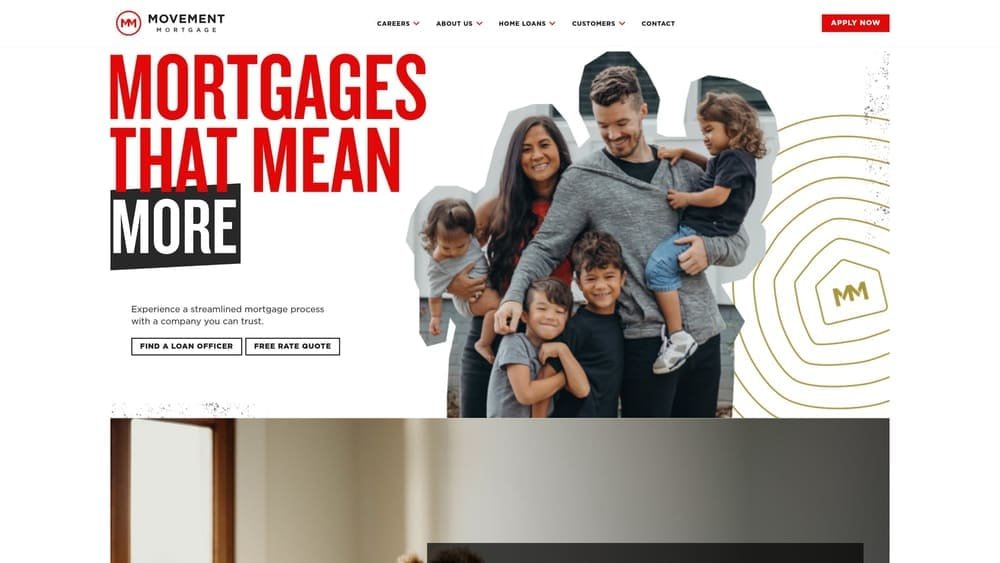
Movement Mortgage is a retail lender known for its purchase-transaction focus and a marketed fast-processing model that has resonated with real estate agents in many markets.
Where This Lender Shines
Movement’s differentiation is largely operational: the lender has built its brand around a fast-close commitment that appeals to listing agents and sellers in competitive markets. For a conventional or government-backed purchase within the conforming limit, that speed positioning can be a real advantage when competing on offer terms.
As a retail lender with a standard program menu, Movement operates on a single pricing shelf. Jumbo and non-QM capacity is limited compared to what a wholesale broker can access. A hard pull is required at application, and the document checklist is standardized for conventional retail underwriting rather than adaptable to complex income scenarios.
Key Features
Purchase-Transaction Focus: Marketed fast-close processing model designed to compete in active purchase markets.
Standard Government Program Menu: Conventional, FHA, VA, and USDA programs available.
Retail Pricing: Single lender shelf with no wholesale access or multi-lender rate comparison.
Hard Pull at Application: Credit inquiry required before pre-approval is issued.
Limited Jumbo and Non-QM Flexibility: Program depth for complex files is more constrained than a broker with wholesale lender access.
Best For
Conventional, FHA, VA, or USDA buyers within the conforming limit who are in competitive purchase markets and whose real estate agent values the lender’s fast-close positioning. Not the optimal choice for jumbo buyers, self-employed borrowers, or investors.
Pricing
Retail lender; fees and rates vary by loan program and borrower profile.
4. Guild Mortgage
Best for: Buyers seeking a broad government and conventional program menu with in-person branch access.
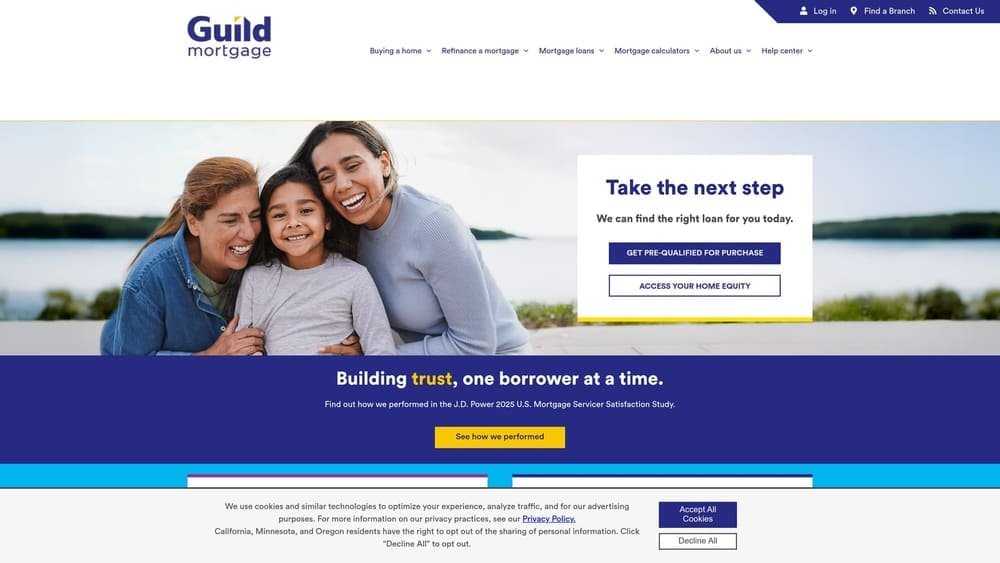
Guild Mortgage is a retail lender with a wide government and conventional program menu, including FHA, VA, USDA, and renovation loan products, supported by an in-person branch model across many markets.
Where This Lender Shines
Guild’s breadth within the retail government-program space is a genuine strength. If your loan is FHA, VA, or USDA, or if you need a renovation product like a 203(k), Guild’s program menu covers more ground than many retail competitors. The in-person branch model also appeals to borrowers who prefer face-to-face consultation over a fully digital process.
The structural limitations are consistent with any retail lender: one pricing shelf, no wholesale access, and a hard pull required at application. Non-QM and jumbo depth is limited compared to an independent broker with access to multiple wholesale investors. For a Virginia buyer above $806,500 with complex income, the single-shelf model creates program constraints that wholesale access resolves.
Key Features
Broad Retail Program Menu: FHA, VA, USDA, conventional, and renovation loan products available under one roof.
In-Person Branch Model: Physical branch locations for borrowers who prefer in-person consultation.
Limited Non-QM and Jumbo Depth: Program access for complex income types and jumbo loans is more constrained than a wholesale broker.
Best For
Buyers using government-backed programs (FHA, VA, USDA) or renovation financing who want in-person branch support and a broad standard program menu. Less suited to jumbo buyers, self-employed borrowers, or investors needing non-QM programs.
Pricing
Retail lender; rates and fees vary by program. In-person consultation available at branch locations.
5. Alcova Mortgage
Best for: Virginia buyers who prioritize local market knowledge and in-state branch relationships for conventional, FHA, or VA loans.
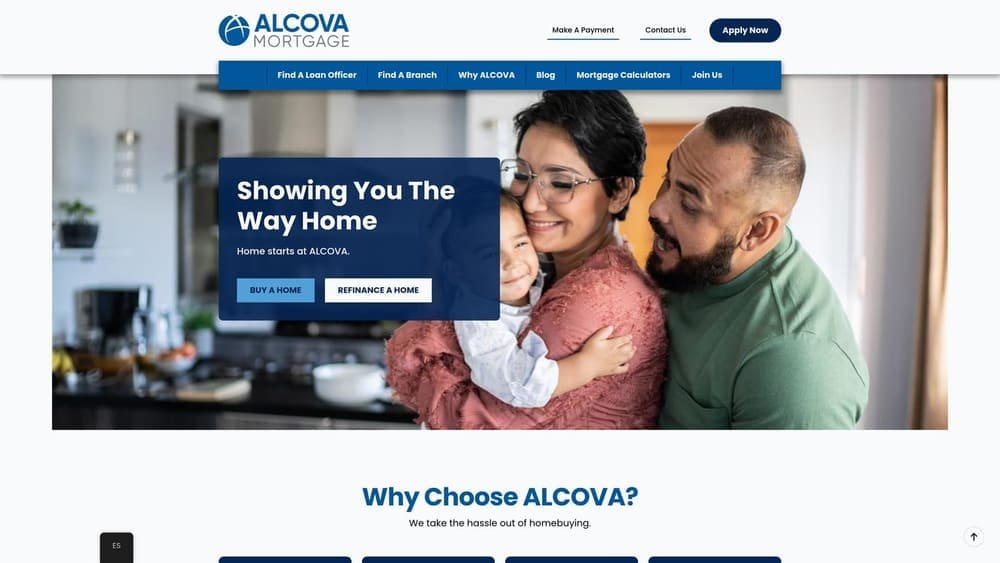
Alcova Mortgage is a Virginia-headquartered retail lender with regional branch presence across key Virginia markets, including Richmond, Charlottesville, and Hampton Roads.
Where This Lender Shines
Alcova’s local Virginia presence is its most meaningful differentiator. Loan officers with deep familiarity in specific Virginia submarkets — the Richmond metro, the Charlottesville area, Hampton Roads — can offer insight into local appraisal patterns, seller expectations, and market timing that a national digital lender cannot replicate. For buyers who value a community lending relationship, that local context matters.
As a retail lender, Alcova operates on a single pricing shelf with conventional, FHA, and VA programs as its core menu. Jumbo and non-QM capacity is limited relative to a wholesale broker with access to multiple investors. A hard pull is required at application. For a Virginia buyer above the $806,500 conforming baseline with self-employment income or investor qualification needs, the retail single-shelf model is a structural constraint.
Key Features
Virginia Market Presence: Regional branch network with local loan officers in Richmond, Charlottesville, Hampton Roads, and other Virginia markets.
Conventional, FHA, and VA Programs: Standard community lender program menu for purchase and refinance.
Retail Pricing Structure: Single lender shelf; no wholesale access.
Hard Pull at Application: Credit inquiry required before formal pre-approval.
Limited Jumbo and Non-QM Capacity: Program depth for complex files is more constrained than a wholesale broker with multi-lender access.
Best For
Virginia buyers purchasing within the conforming limit with conventional, FHA, or VA loan needs who value local branch relationships and regional market familiarity. According to the Virginia Association of Realtors market data, median home prices in many Virginia markets are approaching or exceeding the conforming baseline, making lender program depth an increasingly important consideration for move-up buyers.
Pricing
Retail lender with Virginia-focused branch pricing. Rates vary by program and borrower profile.
6. NFM Lending
Best for: Borrowers seeking conventional and government programs with some niche product availability, including doctor loans.
NFM Lending is a multi-state retail lender offering conventional, FHA, VA, and USDA programs alongside some niche products, including doctor loan options for qualifying professionals.
Where This Lender Shines
NFM’s niche product inclusion — particularly doctor loans — gives it a modest differentiation within the retail lender category. For a physician or dentist with significant student debt and a strong income trajectory, a doctor loan program that excludes student debt from DTI calculation can be meaningful. That is a specific borrower scenario where NFM’s program menu extends slightly beyond the standard retail template.
Outside that niche, NFM operates as a standard retail lender: one pricing shelf, no wholesale access, conventional and government programs, and a hard pull required at application. Non-QM and jumbo depth is limited compared to a wholesale broker. For a Virginia jumbo borrower or a self-employed buyer, the structural constraints of the retail model apply here as they do across all retail lenders on this list.
Key Features
Conventional and Government Program Menu: FHA, VA, USDA, and conventional programs available for purchase and refinance.
Doctor Loan Program: Niche product for qualifying medical professionals that may exclude student debt from DTI calculation.
Best For
Conventional and government-backed borrowers, particularly medical professionals who may benefit from doctor loan program terms. Less suited to self-employed borrowers, jumbo buyers above $806,500, or investors needing DSCR qualification.
Side-by-Side Lender Comparison
| Lender | Loan Types | Jumbo Eligible | Non-QM Available | Soft Pull Pre-Approval | Pricing Structure | FICO Floor (Approx.) | Lender Fee Structure |
|---|---|---|---|---|---|---|---|
| Supra Mortgage | Conventional, Jumbo, Non-QM, Bank Statement, DSCR, Asset Depletion, High-Balance | Yes — above $806,500 and $1,249,125 | Yes — multiple programs | Yes — NoTouch Credit Pull | Wholesale — no retail markup | Varies by program (non-QM as low as 620) | Wholesale lender fee; no disclosed broker fee |
| Rocket Mortgage | Conventional, FHA, VA, Jumbo (limited) | Limited | Limited | No — hard pull typically required | Retail — single shelf | ~620 conventional | Retail lender fees; varies by loan type |
| Movement Mortgage | Conventional, FHA, VA, USDA | Limited | Limited | No — hard pull required | Retail — single shelf | ~580–620 | Retail lender fees; varies by program |
| Guild Mortgage | Conventional, FHA, VA, USDA, Renovation | Limited | Limited | No — hard pull required | Retail — single shelf | ~580 FHA; ~620 conventional | Retail lender fees; in-person consultation |
| Alcova Mortgage | Conventional, FHA, VA | Limited | Limited | No — hard pull required | Retail — Virginia-focused | ~620 conventional | Retail lender fees; local branch pricing |
| NFM Lending | Conventional, FHA, VA, USDA, Doctor Loan | Limited | Limited | No — hard pull required | Retail — single shelf | ~580–620 | Retail lender fees; varies by program |
Frequently Asked Questions
What documents are on a standard mortgage application checklist?
The standard mortgage application checklist typically includes two years of federal tax returns, W-2s or 1099s, recent pay stubs (last 30 days), two to three months of bank statements, documentation of all asset accounts, a government-issued ID, and the executed purchase contract. The CFPB’s mortgage document guidance provides a baseline framework. The specific checklist expands or changes based on income type, loan size, and the lender’s program requirements.
Does getting pre-approved hurt my credit score?
A formal pre-approval from most retail lenders requires a hard credit inquiry, which can temporarily lower your credit score by a small number of points. Multiple hard pulls within a short window for the same loan type are generally treated as a single inquiry by the major credit bureaus. However, if you want to confirm eligibility before any hard inquiry is initiated, a no hard inquiry mortgage pre approval is available through the NoTouch Credit Pull process at Supra Mortgage.
What is a NoTouch Credit Pull and how does it work?
The NoTouch Credit Pull is a broker-exclusive process where a soft credit inquiry is used to review your credit profile, confirm program eligibility, and identify the most suitable wholesale lender for your file — all without a hard inquiry appearing on your credit report. This is structurally different from what retail lenders offer. A soft credit pull mortgage review gives you program clarity and indicative pricing before you formally commit to an application. Contact Duane Buziak at 804-212-8663 to initiate this process.
How does the mortgage checklist differ for a jumbo loan above $806,500?
Jumbo loans above the 2026 FHFA baseline of $806,500 — and especially those above the high-cost ceiling of $1,249,125 — typically require more extensive documentation than conforming loans. Lenders generally require 12 to 24 months of bank statements, documentation of all liquid reserves (often six to twelve months of PITI), a more detailed asset paper trail, and in some cases, a second appraisal. The specific requirements vary by jumbo investor, which is why wholesale broker access to multiple jumbo lenders creates flexibility that a single retail shelf cannot provide.
What documents do self-employed borrowers need for a mortgage?
Self-employed borrowers on a conventional full-doc loan typically need two years of personal and business tax returns, a year-to-date profit and loss statement, and business bank statements. For a bank statement loan — available through Supra Mortgage’s non-QM wholesale access — the checklist shifts to 12 or 24 months of personal or business bank statements, with tax returns often not required. This is a material difference for self-employed buyers whose tax returns understate actual income due to legitimate deductions.
What is a DSCR loan and what does the checklist look like for investors?
A DSCR (Debt Service Coverage Ratio) loan qualifies the borrower based on the rental income of the subject property rather than personal income. The checklist typically includes a lease agreement or market rent appraisal, the property appraisal, entity documentation (if purchasing in an LLC), and standard asset and credit documentation. Personal tax returns and employment verification are generally not required. This program is available through Supra Mortgage’s wholesale non-QM lender access and is designed for real estate investors who hold multiple properties or whose personal income documentation does not reflect their actual investment capacity.
What is the 2026 FHFA conforming loan limit in Virginia?
The 2026 FHFA conforming loan limit is $806,500 for standard Virginia markets. In designated high-cost areas, the ceiling rises to $1,249,125. Any loan amount above these thresholds is classified as a jumbo loan and falls outside conventional conforming underwriting guidelines. The official 2026 limits are published at the FHFA conforming loan limit page. Note that the superseded 2025 limit of $1,209,750 no longer applies.
How long does it take to gather mortgage application documents?
For a W-2 borrower with straightforward employment history, gathering the standard checklist typically takes two to five business days, assuming tax returns are filed and bank statements are accessible digitally. For self-employed borrowers, the timeline extends depending on whether business returns are current and whether a CPA needs to prepare a year-to-date P&L. For jumbo or non-QM files, the document scope is broader and may require additional time for reserve documentation and asset verification. Starting the process with a no credit hit mortgage application through the NoTouch Credit Pull allows you to identify exactly which documents are needed before the formal application clock starts.
Choosing the Right Lender for Your Virginia Mortgage
Your mortgage application checklist is not a universal document. It is a function of your income type, loan size, and the programs your lender can actually access. For a W-2 borrower purchasing at $650,000, a retail lender’s standard checklist and single pricing shelf will likely serve you adequately. For a self-employed buyer at $1,100,000, or an investor qualifying on DSCR, the checklist changes entirely — and so does which lender can close the loan at a competitive rate.
Supra Mortgage’s wholesale broker model means the document requirements are matched to the wholesale lender best suited to your file, not forced into a single retail template. The mortgage pre approval without hard pull process through the NoTouch Credit Pull lets you confirm eligibility and program fit before a single hard inquiry touches your credit report. That is a structural advantage that no retail lender on this list can replicate.
For the $1,375,000 Virginia purchase scenario outlined earlier — a $1,100,000 jumbo loan — the difference between a retail single-shelf rate and a wholesale rate matched across multiple jumbo investors can be meaningful over the life of the loan. The checklist is the starting point. The lender determines whether the application succeeds.
Ready to build your personalized mortgage application checklist and confirm your program eligibility without a hard credit pull? Schedule your personalized consultation today with Duane Buziak at 804-212-8663, or start your no credit hit mortgage application at supramortgage.com.